Buying a used hybrid: what to check before you buy
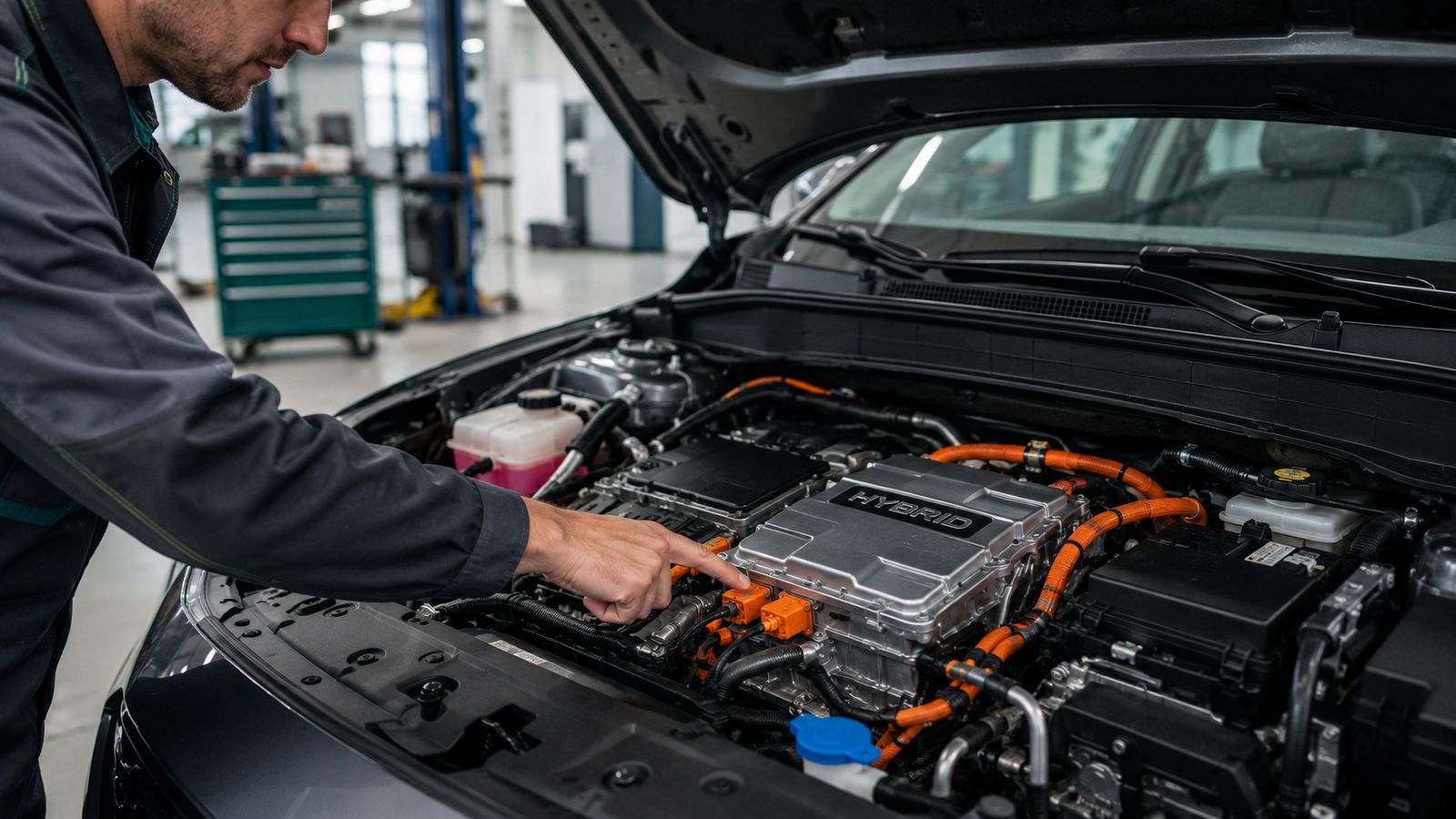
A used hybrid needs the same checks as any used car, plus three hybrid-specific ones: the hybrid battery's actual state of health, the condition of a drivetrain that switches between an engine and electric motor, and whether the manufacturer's hybrid-battery warranty transfers to you. In Consumer Reports' 2026 U.S. survey, hybrids had 15% fewer owner-reported problems than gas-only cars. But J.D. Power's 2026 U.S. dependability study found hybrids at 213 problems per 100 vehicles against 198 for gas-only, a reminder that even within one market, different studies don't always agree. Get a dealer or independent hybrid specialist to run an actual battery health check before you commit, and compare the result against the manufacturer's own warranty terms rather than a rule-of-thumb percentage.
A used hybrid needs every check you'd run on a regular used car, plus three that are specific to how a hybrid works: the actual health of the hybrid battery, the condition of a drivetrain that alternates between a combustion engine and an electric motor, and whether the battery warranty transfers to you as a second owner. A dealer or independent hybrid specialist can run a diagnostic State of Health (SoH) test on the hybrid battery: get that reading in writing and weigh it against the manufacturer's own warranty terms for that specific model, rather than judging it against a generic rule-of-thumb percentage. Reliability data on hybrids is genuinely mixed even within a single market. Don't take any one "hybrids are more reliable" headline at face value without checking what it actually measured.
Why hybrids need a slightly different checklist
A hybrid isn't just a petrol car with a battery bolted on. It runs two power sources that hand off to each other constantly, adds a second cooling circuit for the battery and power electronics, and uses regenerative braking to recover energy instead of relying purely on friction brakes. None of that makes a hybrid inherently riskier to buy used. But it does mean a purely visual inspection and a standard test drive won't catch everything a hybrid-specific problem would show up as. A few extra minutes of checking pays off disproportionately here.
1. How hybrid batteries differ from EV batteries
A hybrid's battery is much smaller than a full EV battery (it exists to support the engine and recover braking energy, not to power the car alone for long distances), but it degrades for broadly similar reasons: age, heat, and deep charge/discharge cycles. Unlike an EV, a failing hybrid battery usually doesn't strand you immediately; the car typically falls back to running on the combustion engine alone, with reduced fuel economy and a dashboard warning, rather than stopping outright. That makes hybrid battery problems easier to miss on a short test drive if you're not specifically looking for the symptoms.
2. Checking the hybrid battery's health before you buy
Ask the seller directly whether the car has had a hybrid battery health check, and if not, get one done before you commit rather than after. Options include:
- Dealer or independent hybrid specialist diagnostic: connects to the car's onboard system and reads an actual SoH percentage, cell balance, and any stored fault codes: the most reliable single check you can run.
- OBD-II scan tool: a basic scan can surface stored trouble codes even without a full SoH readout, and it's a reasonable first pass if a full diagnostic isn't available on the spot.
- Dashboard warning lights: a battery or hybrid-system warning light is worth investigating on its own; don't assume it's a minor sensor issue until a technician confirms that.
- Test-drive symptoms: unusual dips in acceleration, the engine running more than expected at low speed, or a noticeably worse real-world fuel economy than the car's rating can all point to a battery that's no longer holding its charge well.
Once you have an actual SoH reading, don't judge it against a generic rule-of-thumb percentage: compare it against the manufacturer's own written battery warranty terms for that specific VIN (see the documentation checks below). A reading close to or below the manufacturer's stated capacity floor is a concrete reason to negotiate the price down or walk away; a reading comfortably above it is a reasonably solid sign, though "comfortably above" varies by manufacturer and by how much of the warranty term is left (CarBuzz, "Why You Should Always Check Battery Health Before Buying A Used Hybrid").
3. Brakes and regenerative braking: what to inspect
Hybrids use regenerative braking to recover energy under normal deceleration, which means the electric motor does a meaningful share of the slowing-down work and the friction brake pads get used less than they would on a comparable petrol car under the same driving. That's generally good news for pad wear, but it comes with its own inspection points:
- Check pad thickness and rotor condition as you would on any car: don't assume "it's a hybrid, brakes are fine" and skip the physical check.
- Listen and feel for a smooth brake pedal transition. The handoff between regenerative and friction braking should feel seamless; a grabby, inconsistent, or spongy pedal can indicate a problem with the brake system's software or hardware rather than simple pad wear.
- Watch for rust or seized components on brakes that see less friction use. Lower pad usage means the friction surfaces do less self-cleaning work, so light surface corrosion on rotors after a car has sat isn't automatically abnormal: it should clear within the first few stops, not persist.
4. Drivetrain checks specific to hybrids
Beyond the battery and brakes, a hybrid's drivetrain has a few components a standard combustion car doesn't:
| Component | What to check | Why it matters |
|---|---|---|
| Power inverter / power electronics | Ask whether it's ever been serviced or shows fault codes | Converts battery DC power to the AC the motor uses; a failure here is typically expensive |
| Battery cooling system | Confirm the cooling fan or liquid circuit isn't blocked, noisy, or leaking | Poor cooling accelerates battery degradation and can trigger safety shutdowns |
| Engine start/stop cycling | During the test drive, note whether the engine starts and stops smoothly at low speed | Rough, delayed, or unusually frequent engine starts can point to a battery or control-system issue |
| Combined mileage on both power sources | Ask for full service history, not just an odometer reading | A hybrid with heavy stop-and-go use has cycled its battery more than the odometer alone suggests |
5. Reliability: what the data actually shows
This is where a little honesty goes a long way. Two respected U.S. studies looked at hybrid reliability in 2026 and didn't fully agree with each other: a useful reminder that "hybrids are more reliable" isn't a settled fact even within one market, let alone globally.
Consumer Reports' 2026 Annual Auto Reliability Survey, based on member-reported data from roughly 380,000 vehicles across model years 2000 through 2025 (plus early 2026 models), found hybrids had about 15% fewer reported problems on average than gas-only cars, while EVs and plug-in hybrids had substantially more problems than gas-only cars on average. Toyota topped CR's 2026 brand reliability rankings, with Lexus ranked third and BMW fifth (Consumer Reports, "Hybrids Are Still the Most Reliable Cars, CR Survey Shows"). All U.S.-market data based on U.S. owner surveys.
J.D. Power's 2026 U.S. Vehicle Dependability Study, which measures owner-reported problems per 100 vehicles (PP100) after three years of ownership, found the opposite ordering between the two powertrains: gas-only vehicles averaged 198 PP100 (the best-performing powertrain in the study), while hybrids averaged 213 PP100, both up year over year. Toyota Motor Corporation still picked up the most model-level dependability awards of any manufacturer in that same study, with eight (J.D. Power, "2026 U.S. Vehicle Dependability Study (VDS)"). Also U.S.-market data, but from a different methodology (a structured owner survey focused specifically on problems in the past 12 months, at exactly three years of ownership).
Two things are true at once here: Toyota and Lexus hybrids show up as strong performers across both U.S. studies, which is a reasonably consistent signal. But the two studies disagree on whether hybrids overall beat gas-only cars, because they measure different things (broad member-reported issues across many model years vs. a structured three-year-ownership survey). Neither study covers markets outside the United States, so treat brand-level reliability claims for your own country's market with real caution unless you can point to a study that actually measured that market.
6. Documentation and warranty checks
Before you sign anything:
- Get the complete service history, with particular attention to any hybrid-system or battery-related work.
- Ask for the manufacturer's written hybrid battery warranty terms for that specific VIN, including how much of the original term and distance allowance is left.
- Confirm explicitly whether the hybrid battery warranty transfers to you as a second owner: this is not automatic with every manufacturer, and some require paperwork to keep coverage active.
- Check whether any hybrid-battery-related recalls apply to the exact model and year, and whether they were carried out.
A Plateop report doesn't pull VIN-linked history from a register itself: it works from the listing, the asking price and verified model knowledge, including where hybrid-specific known issues apply, turning that into checks and seller questions so you're working from documented points rather than taking a seller's word for it, and it's upfront about what it can't confirm. Where your market provides official vehicle data, the report uses it and shows the source. Check any car before you buy at plateop.com.