Accident damage and total loss: how to find hidden repairs
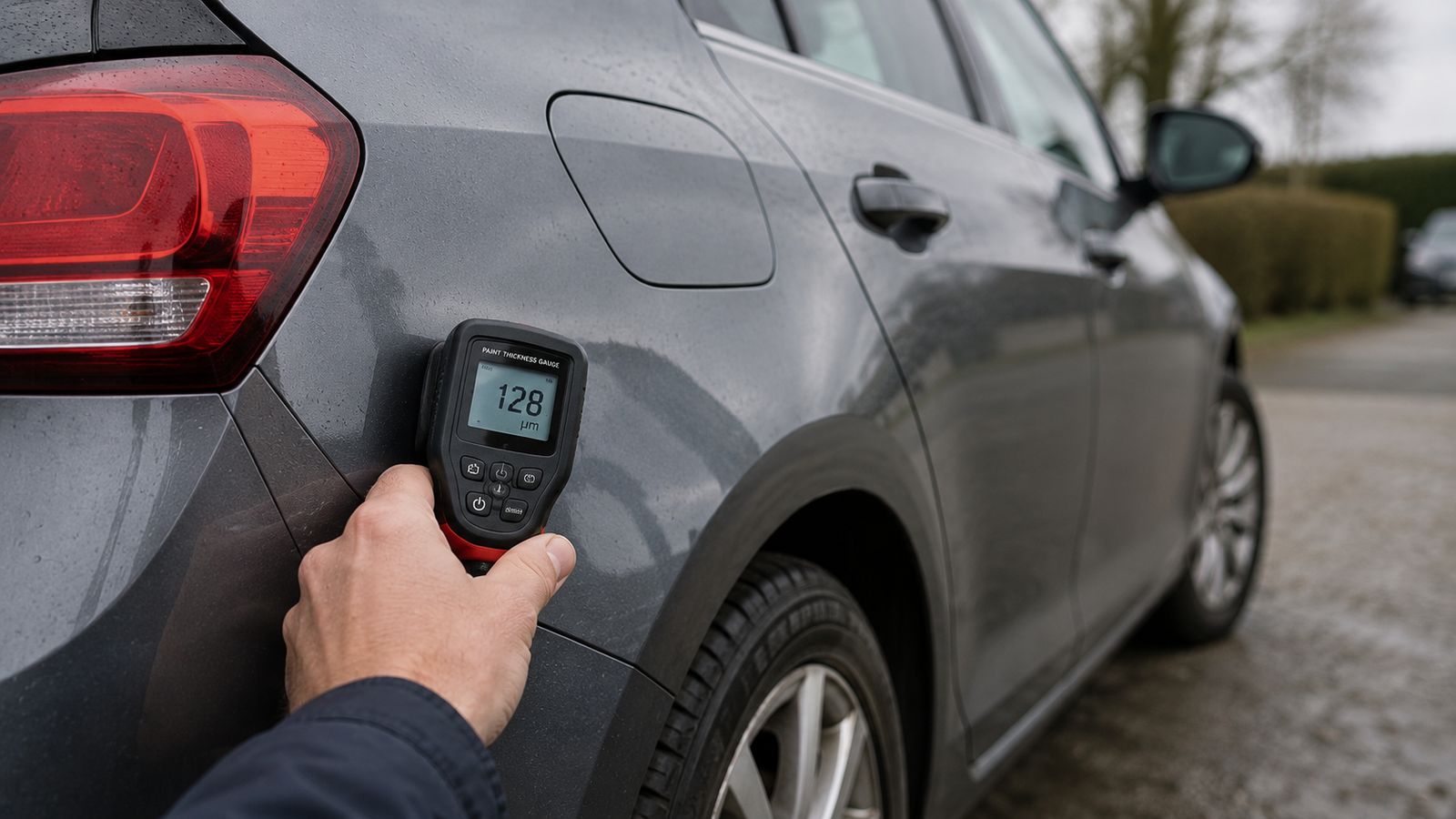
A car doesn't have to look wrecked to have a hidden accident history: repaired panels, structural fixes, and total-loss write-offs can all be resold looking perfectly normal. A paint thickness gauge, a close look at panel gaps, and a vehicle history check together catch most of what a walk-around inspection alone misses. Factory paint typically measures 100-180 microns thick, and what matters most is consistency panel to panel: a single panel that reads clearly different from its neighbours is the red flag, not any specific number. No visual inspection can fully replace a documented history check for confirming a prior write-off.
A repaired car can look completely normal in photos and even in person. That's the problem. The most reliable ways to catch hidden accident damage are a paint thickness gauge (consistent readings from panel to panel matter more than any single number: a panel that reads clearly different from its neighbours signals a repaint), a close inspection of panel gaps and alignment, and a documented vehicle history check that can confirm whether the car was ever declared a total loss. None of these alone is conclusive; used together, they catch most of what a casual walk-around misses.
Why this matters
Sellers aren't always hiding something on purpose. A car that's been through a proper, professional repair after a minor collision can be perfectly safe to drive. The risk is the other case: a car with unresolved structural damage, a poor-quality repair, or an undisclosed total-loss history, resold as if nothing happened. Because paint, bodywork, and detailing can hide a lot in a five-minute test drive, buyers need a few specific techniques rather than a general "look it over" approach.
1. What "total loss" actually means
A vehicle is generally classified as a total loss (or "write-off") when the cost of repairing it, plus any related costs, would be close to or greater than what the car is worth on the market, not necessarily when it's destroyed beyond recognition (Wikipedia, "Total loss"). A written-off car can still be roadworthy in theory; it was declared uneconomical to fix, not necessarily undriveable.
This is why "total loss" isn't a single global standard. Insurers calculate it against a car's actual market value at the time, and many countries have their own formal classification systems that separate structural damage (frame, chassis, safety-critical components) from non-structural damage (cosmetic, mechanical-only). The categories, thresholds, and what happens to the vehicle afterward (repairable-with-registration, or permanently retired) differ by country and by insurer. If you're evaluating a specific write-off history, check what system applies where the car is registered rather than assuming your home country's rules apply everywhere.
2. Structural vs. cosmetic damage: why the difference matters more than the price tag
Two cars can carry the same "it had a repair" description and mean very different things:
| Damage type | What's affected | Typical concern |
|---|---|---|
| Cosmetic | Paint, bumper covers, trim, non-structural panels | Usually a fair-quality repair resolves it fully; mainly a negotiation point |
| Non-structural mechanical | Radiator, lights, minor suspension components | Depends on repair quality; verify with a mechanic |
| Structural | Frame, chassis rails, pillars, floor pan | Can affect crash safety and long-term durability even after repair; the highest-scrutiny category |
A car that's had structural work isn't automatically a bad buy, but it's the category where "who did the repair, and how well" matters most, and where hidden shortcuts are hardest to spot without the right tools. A rushed or budget structural repair can look fine in a showroom and still leave the car out of alignment in ways that only show up as uneven tyre wear, a pull to one side, or reduced crash protection later on, none of which are obvious from a five-minute walk-around.
3. How to check paint thickness for hidden repairs
Most factory paint jobs measure in a fairly consistent range, typically around 100-180 microns depending on the manufacturer and panel, a figure from paint-thickness-gauge maker DeFelsko rather than an independent standards body (DeFelsko, "How to Use Paint Thickness Gauges for Better Automotive Detailing"). What matters for spotting a repair isn't hitting an exact number: it's consistency across the car. A handheld digital paint thickness gauge (inexpensive and widely available) measures the combined coating thickness at each point using magnetic or ultrasonic sensors.
The signal to watch for: a large difference in readings between adjacent panels. If, for example, one door reads notably thinner or thicker than the panel next to it, that panel has likely been repainted at some point. DeFelsko's own guidance is that consistency matters more than hitting an exact number, and that "areas of much greater thickness may indicate rework" (DeFelsko). That doesn't automatically mean an accident (bumpers get repainted for other reasons too), but it's a strong prompt to ask the seller directly and to look harder at that specific area.
4. Panel gaps and misalignment: what your eyes can catch
Consistent, even gaps between body panels indicate the car left the factory properly aligned and has stayed that way. Uneven gaps or panels that don't sit flush with their neighbours are a recognised indicator of a car that was in a collision and not perfectly put back together (Capital One Auto Navigator, "Why Car Panel Gaps Matter"). To check:
- Walk around the car in good daylight and sight down each body line from a low angle.
- Compare the gap width on both sides of the car: a door gap that's noticeably wider on one side than the other is a flag.
- Open and close doors, the bonnet, and the boot and listen and feel for resistance or misalignment.
- Check that gaps taper evenly rather than widening or narrowing unevenly along a seam.
Minor variation is normal. Manufacturing isn't perfect either. It's the obvious, one-sided misalignment that's worth investigating further.
5. Other signs of a hidden repair
Beyond paint and gaps, a few other signals are worth a specific look:
- Overspray: paint on trim, rubber seals, door hinges, or window rubber that shouldn't be painted, often left behind by a rushed repaint.
- Mismatched fasteners: bolts with chipped paint, tool marks, or a different finish than the surrounding ones, a sign a panel has been off the car.
- New parts with old surroundings: a fresh-looking headlight or bumper support next to visibly aged components nearby.
- Under the car: fresh undercoating or welds in one specific area rather than a uniform factory finish.
None of these prove an accident on their own. But two or three together in the same area of the car are a strong reason to get an independent mechanic's opinion before buying. Bring a torch: overspray and mismatched fasteners are far easier to spot in the wheel arches, door jambs and under the bonnet than in the ambient light of a driveway or car park.
It also helps to work systematically rather than scanning the whole car at once. Check one corner of the vehicle at a time (front-left, front-right, rear-left, rear-right) and compare what you find across corners. A single repainted door is unremarkable on its own; a repainted door plus a slightly wider gap plus fresh undercoating underneath, all on the same corner of the car, tells a more complete story.
6. What a vehicle history check adds that a visual inspection can't
A physical inspection, however careful, can only tell you what's visible or measurable on the day you look. It can't tell you whether an insurer formally declared the car a total loss, whether a claim was filed and the car was bought back and repaired for resale, or whether the car was previously registered in a way that hides part of its history. A documented vehicle history check cross-references the VIN against available insurance, registration, and inspection records to flag that kind of history directly: the piece that a walk-around, a paint gauge, and even a mechanic's inspection genuinely cannot see on their own.
A Plateop report doesn't pull VIN-linked history from a register itself: it works from the listing, the asking price and verified model knowledge, turning that into specific checks and seller questions so you're not relying on paint thickness and panel gaps alone, and it's upfront about what it can't confirm for your car. Where your market provides official vehicle records (including total-loss or salvage flags), the report uses them and cites the source. Check any car before you buy at plateop.com.